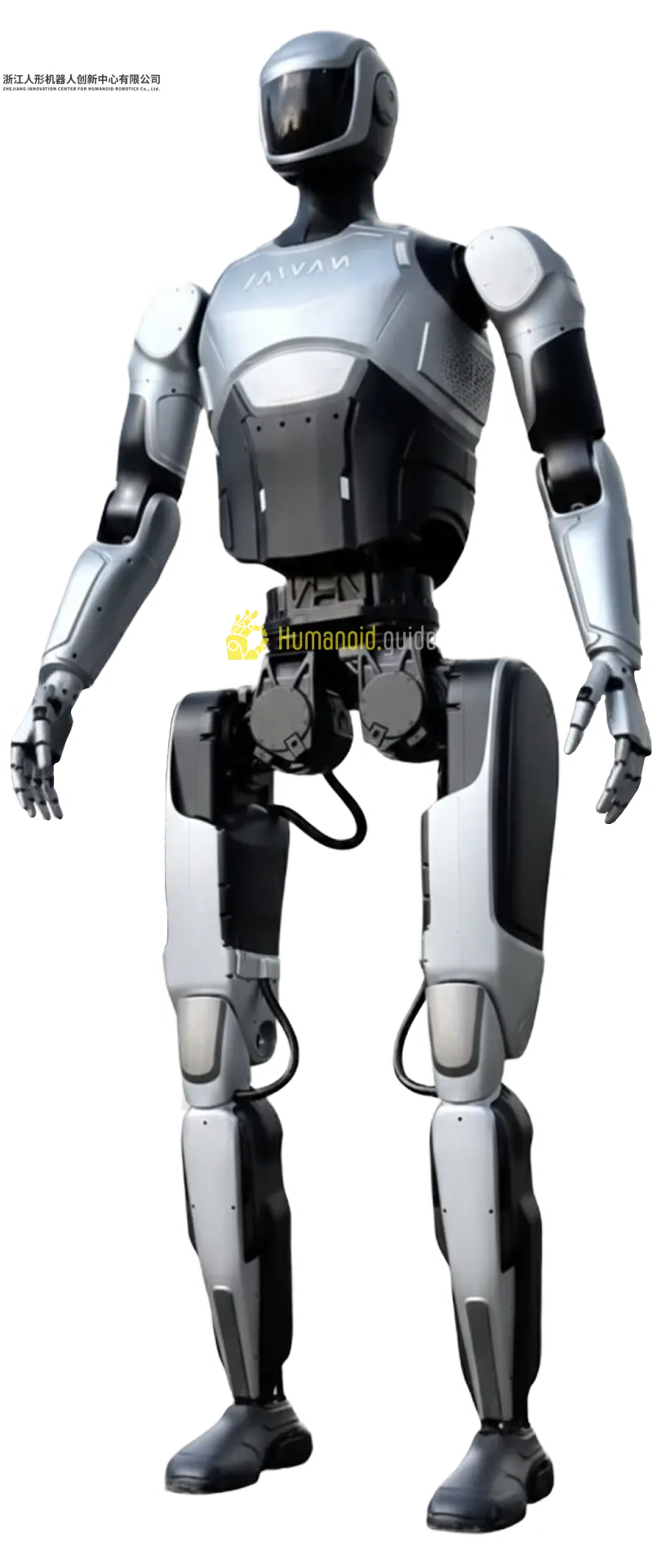
NAVAI-I3
$ 120 000

Zhejiang Humanoid Robot Innovation Center
The Navai-I3 is a Chinese humanoid robot built for stability, mixed-terrain mobility, and research-focused applications. It offers balanced movement, adaptable locomotion, and a versatile platform for future development.
Skill Score
 2
2

Specifications and details:
| Availability | Prototype |
|---|---|
| Nationality | China |
| Website | https://www.zj-humanoid.com/ |
| Degrees of freedom, overall | 44 |
| Degrees of freedom, hands | 14 |
| Height [cm] | 180 |
| Manipulation performance | 2 |
| Navigation performance | 4 |
| Max speed (km/h) | 9 |
| Strength [kg] | 5–10 kg per arm |
| Weight [kg] | 70 |
| Runtime pr charge (hours) | 2 |
| Safe with humans | Yes |
| CPU/GPU | ARM + embedded GPU |
| Ingress protection | IP20 |
| Camera resolution | 1080p RGB + depth camera |
| Connectivity | Ethernet, Wi-Fi, Bluetooth, 5G |
| Operating system | Likely Linux + custom robot control stack |
| LLM integration | N/A |
| Latency glass to action | 150–250 ms |
| Motor tech | Electric servo motors |
| Gear tech | Likely harmonic drives for precision |
| Main structural material | Aluminum frame + composite panels |
| Number of fingers | 5 per hand |
| Main market | Research institutions, robotics labs, AI development, demonstrations |
| Verified | Not verified |
| Walking Speed [km/h] | 4 |
| Shipping Size | 200 × 80 × 60 cm |
| Color | White/grey (prototype) |
| Manufacturer | Zhejiang Humanoid Robot Innovation Center |
Description
The Navai-I3 stands as a strong example of China’s rapid progress in next-generation humanoid robotics. It focuses on stability, smooth motion, and practical field performance rather than flashy demonstrations. Because of this approach, the robot feels more dependable and purpose-driven than many early-stage prototypes. Moreover, its design highlights balance, range of motion, and awareness of the environment.
2026 Humanoid Robot Market Report
160 pages of exclusive insight from global robotics experts – uncover funding trends, technology challenges, leading manufacturers, supply chain shifts, and surveys and forecasts on future humanoid applications.

Featuring insights from
Aaron Saunders, Former CTO of
Boston Dynamics,
now Google DeepMind

2026 Humanoid Robot Market Report
160 pages of exclusive insight from global robotics experts – uncover funding trends, technology challenges, leading manufacturers, supply chain shifts, and surveys and forecasts on future humanoid applications.
Engineers built the Navai-I3 to handle mixed terrain and real-world surfaces. It walks with steady posture, then quickly adapts when the ground changes under its feet. Thanks to its optimized locomotion, it can shift between slow, deliberate steps and faster movement when needed. Although the robot targets research and industrial development, it also offers a glimpse of how future service robots may operate among people.
The robot’s creators focus strongly on versatility. Therefore, the Navai-I3 supports tasks that require controlled motions, safe interaction zones, and consistent operation. Its frame, sensors, and controller stack work together to deliver responsive maneuvering, which helps in structured environments like labs and testing facilities. Additionally, its speed potential hints at future roles in logistics, inspection, or facility support.
I’m Olivia, Humanoid Analyst at Humanoid.Guide
My mission, together with the team, is to help your organization understand the landscape, compare solutions, and move toward successful robot deployments.
Overall, the Navai-I3 aims to serve as a robust foundation for China’s humanoid robotics ecosystem. It blends mobility, adaptability, and a modern development platform that invites research institutions to build new applications. As robotics moves toward wider deployment, the Navai-I3 positions itself as a capable bridge between early lab models and the next generation of functional humanoid solutions.
Download the Humanoid Robot Market Report here