Neura Robotics Reportedly Raising $1.2B for Humanoids
Neura Robotics GmbH is reportedly in talks to raise €1 billion, or about $1.2 billion, in a new funding round that would further accelerate development of its humanoid robot platform and broader intelligent robotics portfolio.
2026 Humanoid Robot Market Report
160 pages of exclusive insight from global robotics experts – uncover funding trends, technology challenges, leading manufacturers, supply chain shifts, and surveys and forecasts on future humanoid applications.

Featuring insights from
Aaron Saunders, Former CTO of
Boston Dynamics,
now Google DeepMind

2026 Humanoid Robot Market Report
160 pages of exclusive insight from global robotics experts – uncover funding trends, technology challenges, leading manufacturers, supply chain shifts, and surveys and forecasts on future humanoid applications.
According to Bloomberg, the round could include participation from Tether Limited Inc., the issuer of the USDT stablecoin. Earlier reports from the Financial Times suggested that Tether was considering backing a major raise for the German robotics company. Previous expectations placed Neura’s valuation between €8 billion and €10 billion. Bloomberg now reports that the company may secure a valuation closer to €4 billion, with the possibility of additional fundraising to follow.
Humanoid Platform at the Core
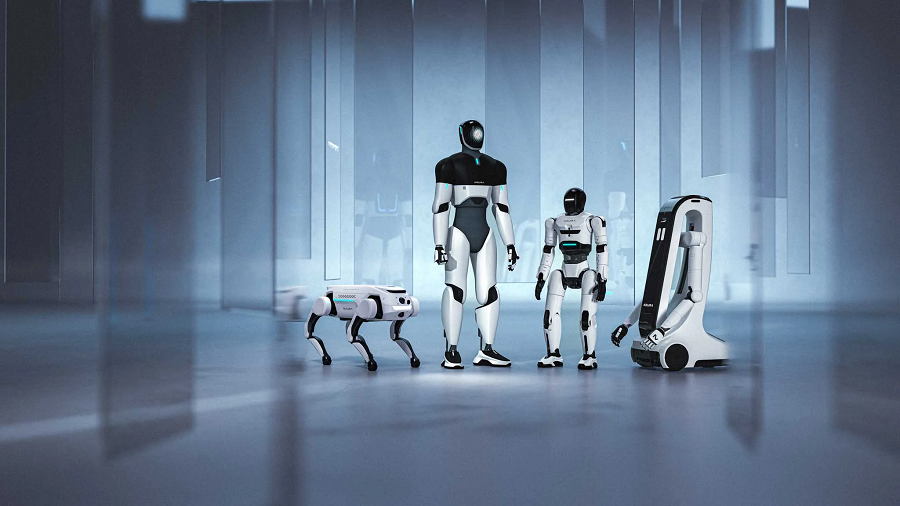
Neura Robotics develops a range of AI enabled robotic systems, with humanoid robots positioned as a central pillar of its strategy. Its flagship humanoid platform, the 4NE1 Mini, stands 5.9 feet tall and is designed to carry payloads of up to 220 pounds. The system is capable of moving at speeds of roughly three miles per hour and is marketed for both industrial and consumer use cases.
The company states that the 4NE1 Mini can understand natural language instructions, reflecting Neura’s emphasis on onboard artificial intelligence and multimodal interaction. The humanoid form factor is intended to operate in environments built for people, which may reduce the need for infrastructure changes in factories, warehouses, and potentially residential settings.
In addition to the 4NE1 Mini, Neura introduced a Neural Quadruped Robot earlier this year, expanding its mobility portfolio to include legged systems optimized for uneven or difficult terrain. While not humanoid, the quadruped underscores the company’s broader ambition to deliver adaptive robotic platforms powered by proprietary AI software.
Industrial Robotics and Modular Expansion
Beyond humanoids, Neura competes in the industrial automation market with robotic arms that can be configured through a visual interface rather than traditional custom coding. The company also offers hardware modules designed to enhance sensing and skill acquisition. Its SenseKit module improves environmental perception, while another add on allows operators to teach robotic arms new tasks by manually demonstrating motions.
Neura also markets wheeled logistics robots capable of transporting loads of up to 1.5 tons. These systems were strengthened by the acquisition of ek Robotics GmbH, a 300 person industrial automation specialist focused on warehouse and logistics environments.
For consumer scenarios, Neura offers MiPA, a modular robotic system designed to automate repetitive daily tasks. MiPA features a customizable chassis that can be fitted with attachments such as backpacks, tables, or tools, reflecting the company’s modular hardware strategy.
Capital to Support Scale and Orders
The reported fundraising follows a €120 million round completed about a year ago. That round included backing from Volvo Cars Tech Fund, L Bank, and other institutional investors. At the time, Neura disclosed an order book worth €1 billion, indicating significant commercial interest in its systems.
If completed, the new €1 billion raise would represent one of the largest capital injections into a humanoid robotics company in Europe to date. The funding could support scaling of manufacturing, continued AI development, and further acquisitions as Neura seeks to position itself as a vertically integrated provider of intelligent robotic systems.
For operators and automation decision makers, the raise signals continued investor confidence in humanoid platforms as viable tools for industrial and potentially mixed use environments. The revised valuation expectations also reflect a maturing market in which capital deployment is increasingly tied to demonstrated orders, product readiness, and integration capability.
Source: siliconangle.com