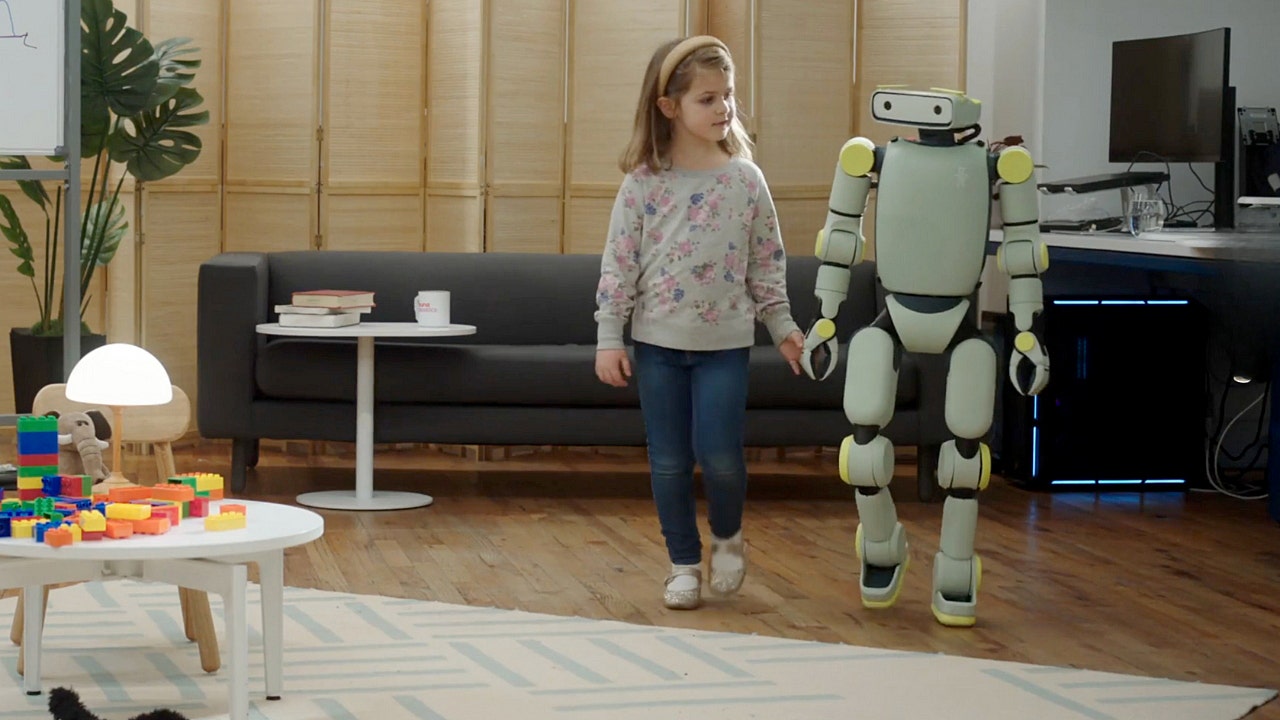
Fauna Robotics Unveils Sprout 29 DOF Humanoid Developer Platform
A Developer Platform Focused on Accessibility
Fauna Robotics, a New York based startup, has launched Sprout, a compact humanoid robot designed as a developer platform for research and experimentation. The company positions Sprout as a step toward making humanoid systems smaller, safer, and more accessible outside of traditional factory cages and restricted lab environments.
2026 Humanoid Robot Market Report
160 pages of exclusive insight from global robotics experts – uncover funding trends, technology challenges, leading manufacturers, supply chain shifts, and surveys and forecasts on future humanoid applications.

Featuring insights from
Aaron Saunders, Former CTO of
Boston Dynamics,
now Google DeepMind

2026 Humanoid Robot Market Report
160 pages of exclusive insight from global robotics experts – uncover funding trends, technology challenges, leading manufacturers, supply chain shifts, and surveys and forecasts on future humanoid applications.
Rather than targeting immediate large scale industrial deployment, Sprout is aimed at developers, research institutions, and robotics teams that require a full featured humanoid form factor in a more manageable package.
Mechanical Design and Degrees of Freedom
Sprout features 29 degrees of freedom, enabling articulated movement across the upper and lower body. This level of actuation supports research into bipedal locomotion, whole body manipulation, balance control, and coordinated arm and leg motion.
While detailed joint torque and payload specifications have not been publicly disclosed, a 29 degree of freedom configuration typically includes:
- Multi axis shoulders and hips for complex range of motion
- Articulated elbows and knees for natural limb movement
- Wrist and ankle joints to support dexterous interaction and balance
- A torso or waist joint for upper body rotation and stabilization
This configuration places Sprout within the range of contemporary research humanoids designed for dynamic tasks rather than static demonstrations.
NVIDIA Compute Integration
Sprout integrates NVIDIA compute hardware, providing onboard acceleration for perception, planning, and control workloads. GPU accelerated processing is increasingly central to humanoid robotics, particularly for real time vision, reinforcement learning inference, and sensor fusion.
By embedding high performance compute directly on the platform, Fauna Robotics aligns Sprout with current development practices that rely on large models and simulation to real world transfer workflows. Onboard AI acceleration reduces dependence on external compute infrastructure and enables lower latency control loops.
Safety and Size as Design Priorities
Fauna Robotics emphasizes that Sprout is designed to operate more safely in closer proximity to people. Although specific safety certifications and force limiting mechanisms have not yet been detailed, the company highlights a shift away from large, heavy humanoids that require strict physical separation.
Smaller form factors can offer several advantages for research and pilot deployments:
- Reduced kinetic energy during unintended contact
- Lower infrastructure requirements
- Simplified transport and lab integration
- Faster iteration cycles for hardware updates
For technical teams evaluating humanoid platforms, these factors can materially affect total cost of ownership and deployment flexibility.
Positioning in the Humanoid Ecosystem
The launch of Sprout reflects a broader trend in humanoid robotics toward modular developer platforms rather than monolithic, single purpose systems. As more companies pursue general purpose humanoids for logistics, manufacturing, and service applications, demand is growing for intermediate platforms that allow teams to prototype software stacks, manipulation strategies, and locomotion policies.
By combining a mid range degree of freedom configuration with NVIDIA based onboard compute, Sprout is positioned as a bridge between academic research platforms and larger commercial humanoids. Its success will depend on the maturity of its control stack, developer tools, and integration support for simulation and AI training pipelines.
For practitioners and technical decision makers, Sprout represents another data point in the ongoing shift toward more compact, developer friendly humanoid systems that prioritize safe interaction and AI ready hardware architectures.