China Unveils National Humanoid Robot Standard System
China has released its first top level standard system for humanoid robots and embodied artificial intelligence, marking a formal shift toward coordinated, standards driven development of the sector.
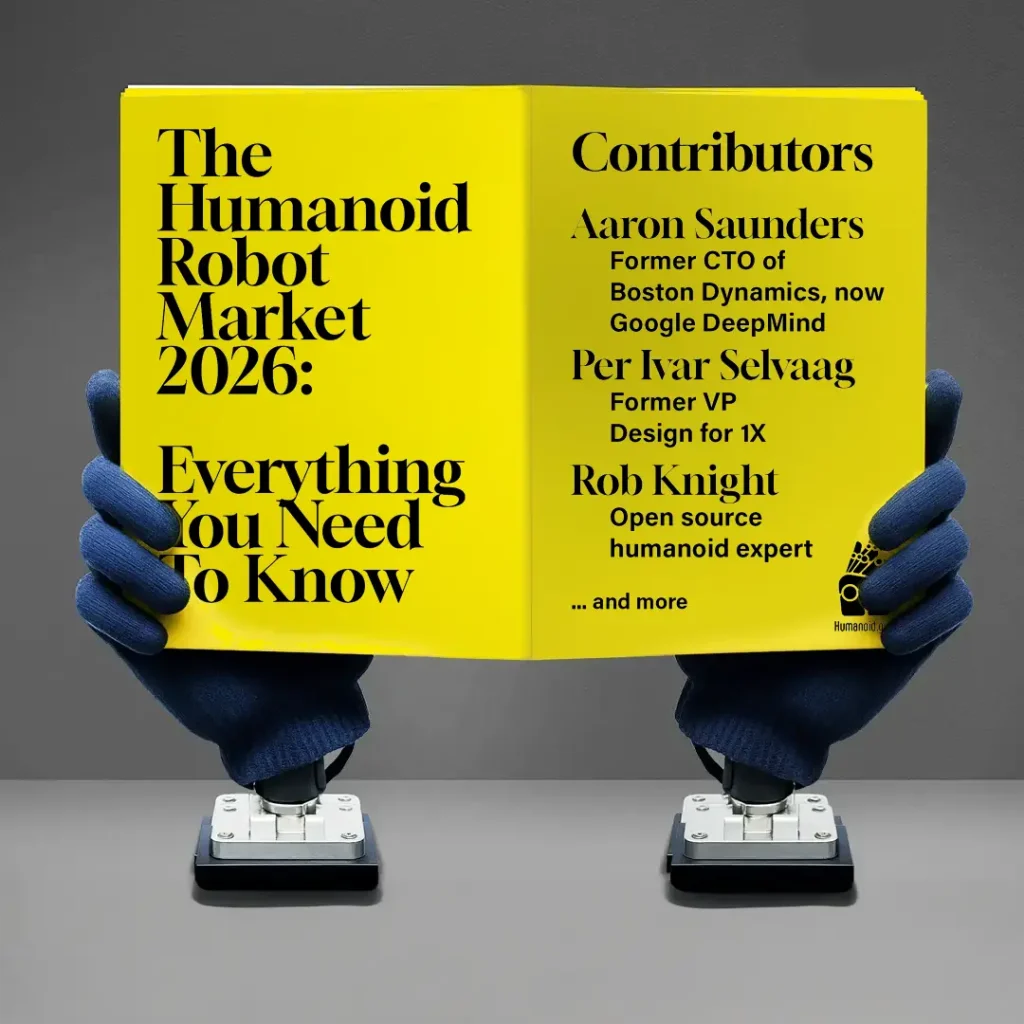
2026 Humanoid Robot Market Report
160 pages of exclusive insight from global robotics experts – uncover funding trends, technology challenges, leading manufacturers, supply chain shifts, and surveys and forecasts on future humanoid applications.

Featuring insights from
Aaron Saunders, Former CTO of
Boston Dynamics,
now Google DeepMind
2026 Humanoid Robot Market Report
160 pages of exclusive insight from global robotics experts – uncover funding trends, technology challenges, leading manufacturers, supply chain shifts, and surveys and forecasts on future humanoid applications.
The framework was announced at the annual meeting of Humanoid Robots and Embodied Intelligence Standardization in Beijing and represents the first major output of the Ministry of Industry and Information Technology’s technical committee for this field, established in December 2025. According to official reporting, the system is designed to cover the entire industrial chain and full life cycle of humanoid robots.
Six Part Technical Architecture
The newly issued standard system is structured around six core sections: basic commonalities, brain like and intelligent computing, limbs and components, complete machines and systems, applications, and safety and ethics.
The basic commonalities and safety and ethics sections provide overarching regulatory and governance guidance. The computing section addresses models described as cerebrum and cerebellum, as well as full link data norms, signaling an effort to standardize both high level reasoning and lower level motion control stacks.
On the hardware side, the limbs and component section introduces modular guidance for torsos and actuators. The complete machine and system section focuses on integration of hardware and software, an area widely seen as a bottleneck for reliability and scalability in humanoid platforms.
From Technical Breakthroughs to System Building
Industry representatives cited in the report characterized the release as a transition from a phase centered on individual technical breakthroughs to one focused on systematic construction. Companies are expected to align product development with unified specifications that support reproducibility, stability, and scalability.
UBTECH described the move as a signal of systematic state guidance for the field, aimed at accelerating ecosystem maturity through top level design. Market participants emphasized that standards will shape long term competitiveness by favoring platforms capable of meeting consistent performance and safety benchmarks.
Context: Rapid Sector Growth
The standard system follows a year of visible momentum for China’s humanoid robot industry. In 2025, national and local policy initiatives positioned humanoid robotics as a strategic technology area. Multiple domestic firms, including Unitree Robotics, Galbot, Noetix, and MagicLab, publicly showcased humanoid platforms during the 2026 Spring Festival Gala, a high profile event that industry analysts described as a demanding test of system stability and integration.
For robotics practitioners and integrators, the introduction of a national standard architecture may reduce fragmentation across control stacks, data formats, safety requirements, and subsystem interfaces. Over time, this could influence procurement criteria, certification pathways, and cross vendor interoperability within China’s humanoid robotics market.
While detailed technical specifications have not been publicly disclosed, the scope of the framework indicates an ambition to formalize everything from foundational components to embodied AI models and application level deployment. As humanoid robots move from research prototypes toward commercial pilots, the existence of a unified standard system is likely to become a central reference point for developers, suppliers, and operators across the ecosystem.
Source: globaltimes.cn