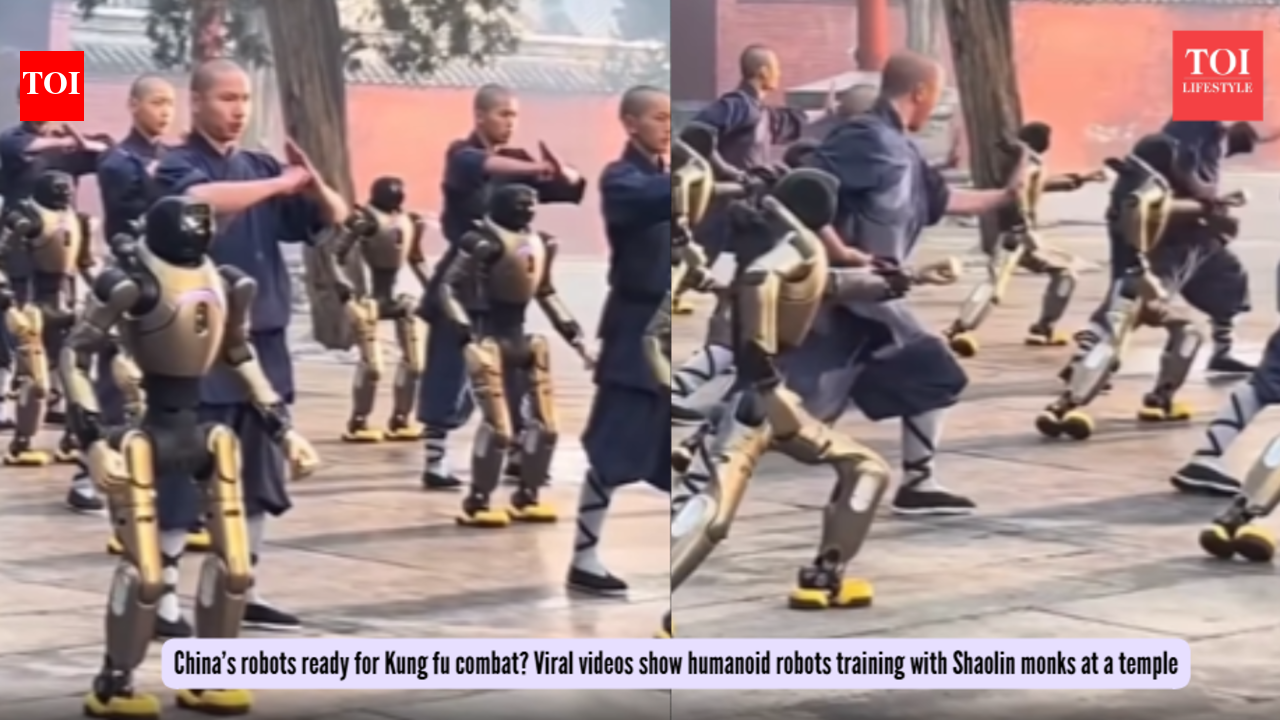
AgiBot humanoids train with Shaolin monks in martial arts demo
Humanoid training at a historic site
Viral footage from China shows humanoid robots developed by Shanghai based AgiBot practicing Kung fu movements alongside monks at the Shaolin Temple. While presented as a cultural moment, the demonstration centers on locomotion, balance, and coordinated motion in human like environments.
2026 Humanoid Robot Market Report
160 pages of exclusive insight from global robotics experts – uncover funding trends, technology challenges, leading manufacturers, supply chain shifts, and surveys and forecasts on future humanoid applications.

Featuring insights from
Aaron Saunders, Former CTO of
Boston Dynamics,
now Google DeepMind

2026 Humanoid Robot Market Report
160 pages of exclusive insight from global robotics experts – uncover funding trends, technology challenges, leading manufacturers, supply chain shifts, and surveys and forecasts on future humanoid applications.
What the demo actually tests
According to publicly available information, the robots are not being prepared for combat scenarios. Instead, the training emphasizes controlled stances, transitions between poses, and synchronized limb movements. These elements are relevant benchmarks for humanoid stability and whole body control, particularly on uneven surfaces and during dynamic motion.
- Balance maintenance during wide and narrow stances
- Coordinated upper and lower body motion
- Repeatable execution of learned movement sequences
AgiBot’s broader humanoid roadmap
AgiBot has positioned its humanoid platforms for real world tasks such as logistics support, inspection, and service roles. Public demonstrations like the Shaolin Temple session are intended to show progress in perception, motion planning, and reinforcement learning rather than application specific features.
The company has previously stated that its focus is on adaptable humanoids that can operate in environments designed for humans, reducing the need for specialized infrastructure.
Implications for humanoid development
For practitioners and system integrators, the value of the demonstration lies in observable control fidelity rather than spectacle. Martial arts forms require precise timing and posture control, making them a compact way to communicate advances in humanoid actuation and software stacks.
More technical disclosures, including actuator specifications, sensing configurations, and training pipelines, will be necessary to assess readiness for industrial or commercial deployment.
Source: The Times of India